
Architects cannow spec Optimawith ease.
We helped Optima showcase their exceptional glass partition systems worldwide with regionalised content. With a document control system, secure logins and full site editing, we make Optima found, trusted, and chosen.
- Client
- Optima
- They make
- World-class glass partitions and doors
- We built
- Nuxt + WordPress
Before
Complex products. A website that made them harder.
Partition systems. Door ranges. Sound ratings, fire ratings, CAD and BIM files. Buyers in 5 regions. The old site put all of it on the page at once.
Architects phoned for spec files.
Datasheets and BIM files were buried or out of date. Every spec waited on a call to Optima’s team.
Fixed in our solutionOne site for the whole world.
US architects got millimetres and UK English. Every figure needed converting before it could go in a spec.
Fixed in our solutionSlow, worst on phones and overseas.
The main photo took 11.5 seconds to show on a phone. Most people won’t wait that long.
Fixed in our solution
How it’s structured
How we did it, layer by layer.
Like one of Optima’s glass walls, the site is built in layers. Watch it come apart and see what each layer does. Skip ahead whenever you like, or drag the drawing to turn it.
Content, kept in WordPress.
This is where Optima’s team works. Words, photos and files all live here. Edit a page, press Publish, done.
- Systems, doors, projects, news and downloads each have their own place.
- WordPress sits at its own address, apart from the public site.
- Editors use normal WordPress screens. No code needed.
Drawings on this page are simplified.
Data, passed up the line.
WordPress doesn’t decide how anything looks. It hands the content over as plain data, a bit like a parts list.
- This is called “headless”. The design is kept apart from the content.
- So the design can change without touching the content, and the other way round.
- One set of content feeds every page and every tool.
The front end, built with Nuxt.
Nuxt takes the data and builds each page from reusable parts: headers, system cards, galleries and forms.
- Pages arrive as finished HTML, so they show quickly and search engines can read them.
- One template serves every system. Another serves every project.
- It also runs the tools: the resource library, the acoustic simulator and the portal.
Delivery: the right size, in the right place.
Before a page reaches you, the details are tuned for your screen and your part of the world.
- Each photo is saved as WebP in several widths, from 320 to 3,200 pixels. Phones get small files.
- Photos further down the page load only when you scroll to them.
- A region picker, plus tags that point search engines to each regional version.
- The site is served through Cloudflare.
The finished page.
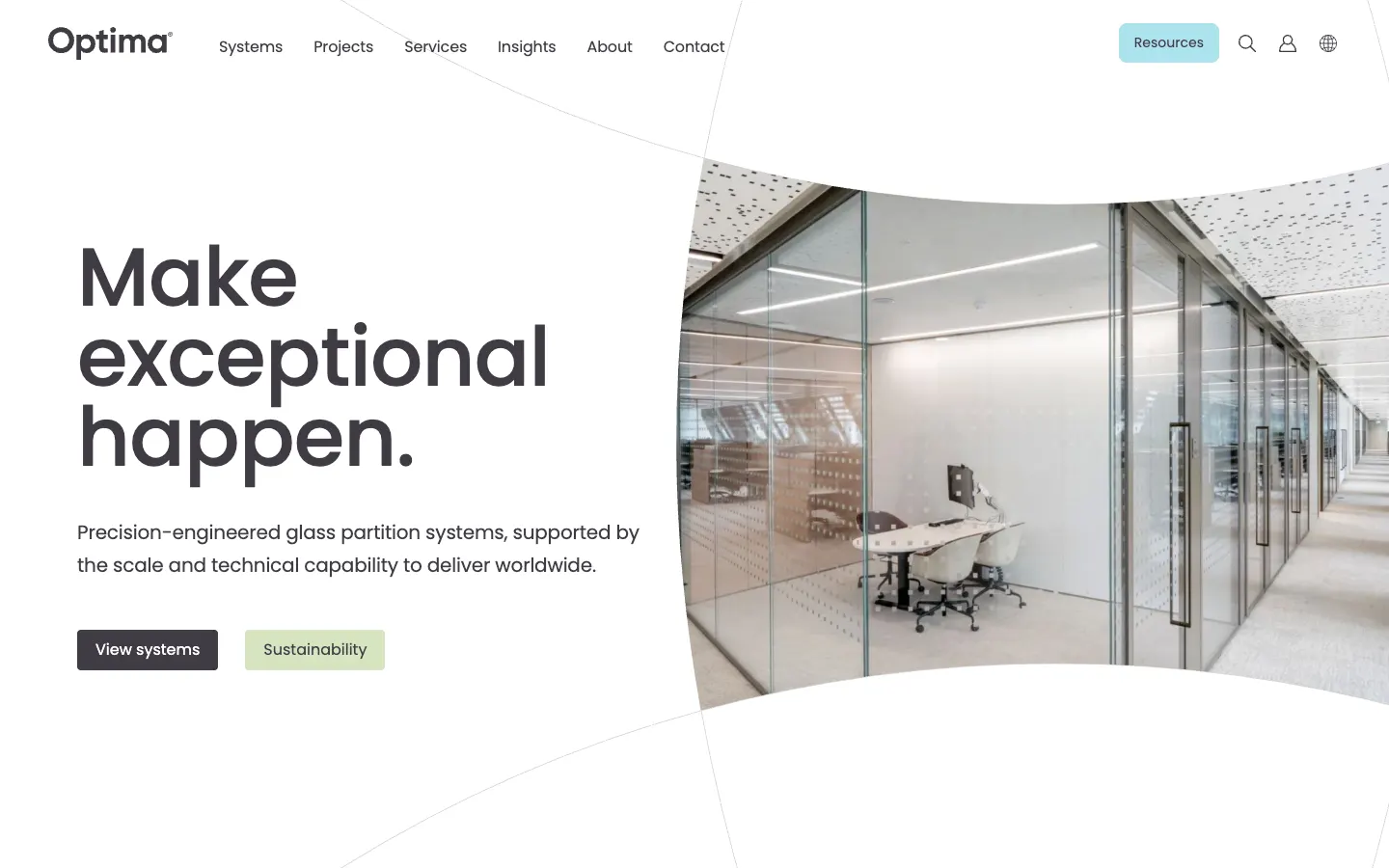
All four layers, pressed flat into one page. This is the live Optima homepage, captured in October 2026.
- What visitors see is simple. The layers underneath keep it that way.
- Every page on the site is built the same way, from the same parts.
Highlights
Some of our favourite bits.
Three parts of the Optima site we especially enjoyed building.
Homepage
A short, bold welcome, then a clear way into the systems.
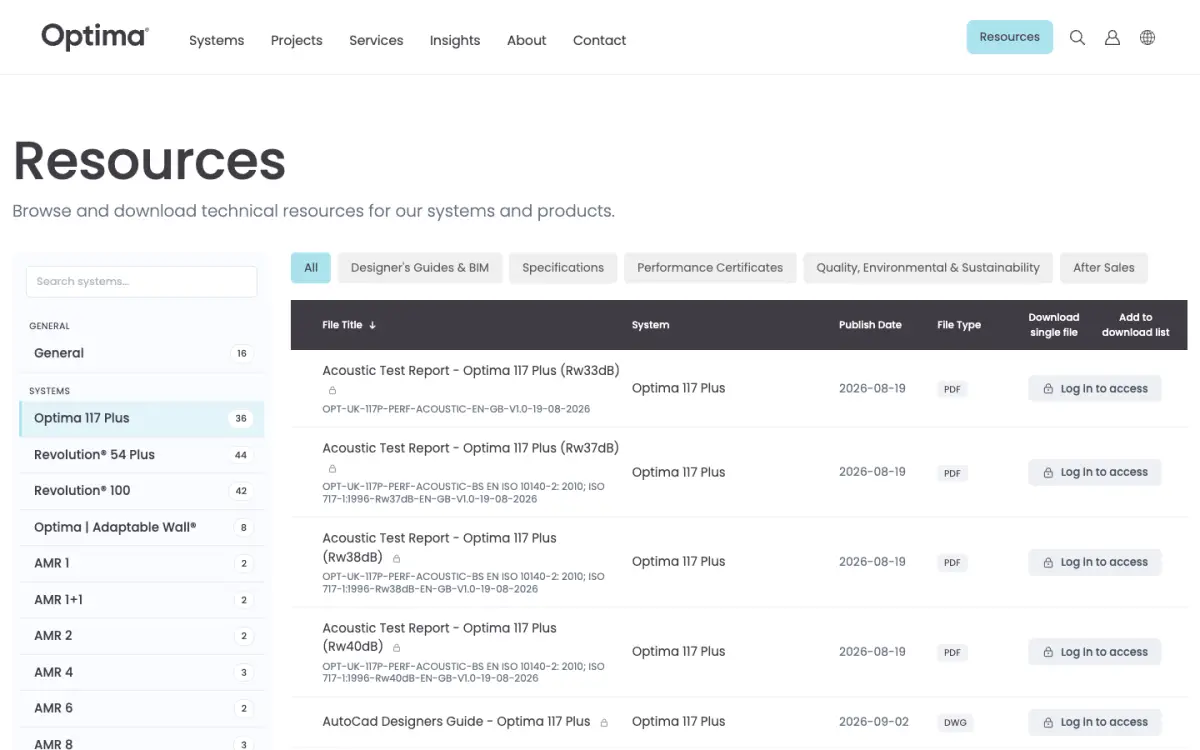
Resource library
Every guide, spec, certificate and test report in one searchable list.
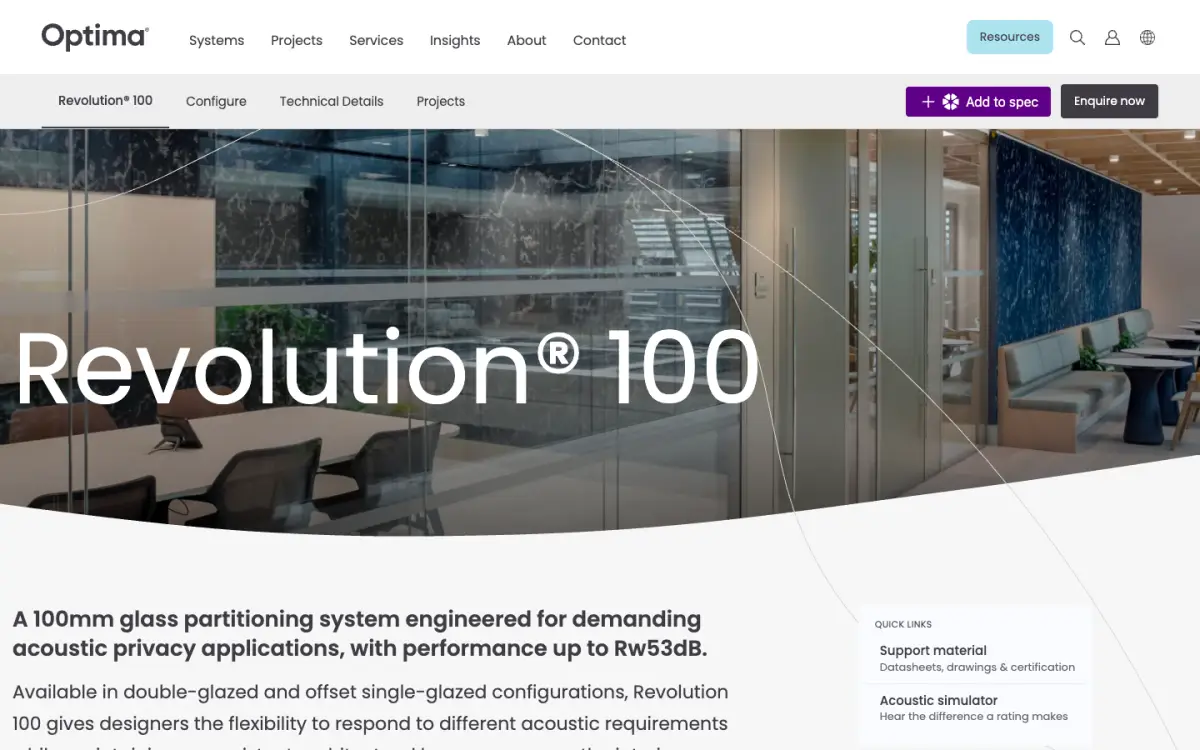
System page
One template for every partition system, from Optima 117 Plus to Revolution® 100.
Your turn
Start your website. Then make it grow.
SEO
Get found for the words your buyers search, in every place you sell.
AI search optimisation
Buyers now ask AI tools who to use. Clear, structured pages make you part of the answer.
CRM & marketing automation
Send enquiries, sign-ups and downloads to your CRM, and follow up at the right time.
Website analytics
See which pages and products get the most interest, and which ones turn into enquiries.
Conversion rate optimisation
Turn more visits into enquiries and sales, with changes tested before they go live.
Content strategy
Guides and case studies that answer buyers’ questions and give search engines more to find.
Start here
Your new website
Tell us what you sell and who buys it. We’ll plan the site with you, build it, and help it grow once it’s live.
Start your projectCredits. Website built by Coullweb. Product names, photos and content belong to Optima.
FAQ
Questions about this build.
Thinking about something similar? These are the questions we hear most.
WordPress holds the content. A separate front end, here built with Nuxt, shows it to visitors. Editors still log in to WordPress as normal. They just never see the code that draws the pages.
It builds pages from reusable parts and sends finished HTML, which helps speed and search. It also makes custom tools easier to build, like a file library or an acoustic simulator.
No. For many sites, normal WordPress is simpler and costs less. Headless earns its place when you have lots of products, files, regions or custom tools. We’ll tell you honestly which suits you.
Yes. Book a call and tell us about your products and your buyers. We’ll suggest a set-up and send a short plan with a fixed price. See website development for how we work.
Start here
Hard product to explain?Let’s draw up your site.
Tell us about your site
A short form. It takes about two minutes.
We book a 30-minute call
We listen, look at your site together and answer your questions.
You get a plan and a price
A short written plan with a fixed price. No pressure to go ahead.